
FORAGING IN AUTUMN: 10 Wild Foods to Find in Hertfordshire
Updated: Aug 24
As summer fades into autumn, Hertfordshire's woodlands, hedgerows and fields become a rich source of seasonal wild foods.
From juicy blackberries, sloes and elderberries to sweet chestnuts, hazelnuts, crab apples and nettles, there is plenty to discover if you know what to look for.
Autumn is also an excellent time to start learning about fungi, although mushrooms should always be approached with particular care because some edible species have highly poisonous lookalikes.
If you're interested in foraging in Hertfordshire, autumn is one of the best times of year to get outside, slow down and discover what nature has to offer.
At Polaris Bushcraft, our private ancient woodland in Bayford provides the perfect setting for learning about wild food, plant identification and responsible foraging.
Here are some of the wild foods you may encounter in Hertfordshire this autumn.
1. Blackberries
Blackberries are one of the easiest wild foods to recognise and are abundant along many paths and hedgerows across Hertfordshire.
The familiar dark purple-black berries ripen from late summer into autumn, although the exact timing varies with weather and location.

They're delicious eaten fresh, but there are plenty of other ways to use them:
Blackberry and apple crumble
Blackberry jam
Blackberry cordial
Pies and tarts
Sauces and desserts
Adding to autumn drinks
Look for plump, dark berries growing on brambles, but take care when reaching into dense hedgerows because the stems are covered in thorns - this is where a stick is useful!
As with all wild food, only collect what you need and leave plenty behind for wildlife.
2. Elderberries
After the familiar creamy white elderflower heads of early summer have disappeared, the elder tree produces clusters of dark purple-black berries.

Elder trees / bushes can be found in hedgerows, woodland edges and other suitable habitats throughout Hertfordshire.
They're commonly used to make:
Elderberry cordial
Elderberry syrup
Sauces
Wines and other drinks
Combined with other fruit in crumbles or pies
Elderberries should be properly cooked before consumption.
We have previously shared our own elderberry cordial recipe, which is a great way to make use of an autumn harvest.
3. Sweet Chestnuts
Autumn is an excellent time to look for sweet chestnuts in woodlands.
The nuts develop inside distinctive cases covered with long, fine, needle-like spikes, not to be confused with the Horse Chestnut. Once mature, they fall to the woodland floor where they can be stamped on to collect the delicious nuts.

Sweet chestnuts are particularly versatile and can be:
Roasted
Boiled
Added to soups and stews
Ground into flour
Used in baking and stuffings
One important identification point is that sweet chestnut is not the same as horse chestnut.
Horse chestnuts (conkers) are not the edible chestnuts you want to collect, so make sure you know the difference before eating anything you find.
We've previously used foraged sweet chestnuts to make homemade sweet chestnut flour, and we've also made sweet chestnut cookies with the resulting flour.
4. Crab apples
Small wild crab apples can be found on trees in hedgerows, woodland and grassland edges.
They are generally much smaller and more sour than the cultivated apples we're used to buying in shops, and come in a range of colours from yellow to deep red.
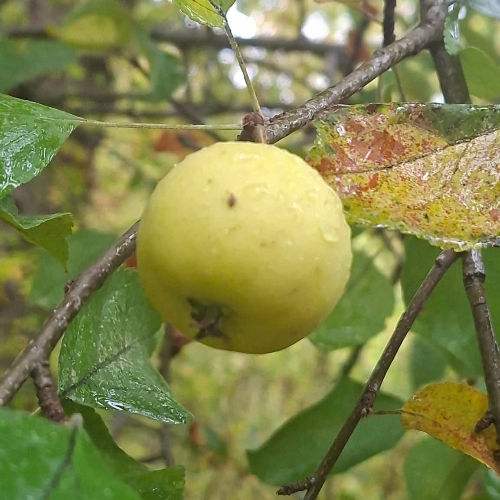
Their sharp flavour makes them useful for cooking plus they contain exceptionally high amounts of natural pectin and acid, making them a perfect ingredient for setting homemade jams and jellies without the need for bought additives.
Try using crab apples for:
Jellies or fruit leather
Chutneys
Sauces
Jams
When identifying any wild apple, look at the tree, leaves and fruit rather than relying on the fruit alone.
5. Hawthorn berries

Hawthorn is a familiar hedgerow tree in Hertfordshire, and its bright red berries, known as haws, become particularly noticeable in autumn.
The berries have traditionally been used in jellies, sauces and other preserves.
Hawthorn can be especially useful when learning to identify trees because its distinctive leaves, thorns and clusters of red berries make it relatively recognisable once you've become familiar with it.
As always, correct identification is essential before eating any wild plant or fruit.
6. Autumn nettles

Most people think of stinging nettles as a spring wild food, but they can also produce a useful flush of fresh growth in autumn.
Young nettle leaves can be used in soups and like spinach in other cooked dishes.
We've previously shared our stinging nettle soup recipe, which explains how to collect and prepare young nettle tops.
Nettles should be collected carefully using gloves or scissors and they should be cooked before eating as heat dstroys the sting!
7. Rosehips
The bright red-orange fruits of the dog rose and other wild and cultivated roses become particularly
noticeable in autumn.

Rosehips have traditionally been used to make syrups, jellies and other preserves and are rich in vitamin C.
They can often be found along hedgerows and woodland margins.
The hairy seeds inside the fruit can irritate the digestive system, so they need to be removed when preparing rosehips for food.
Our guide to preparing rosehips for the syrup explains how to collect and prepare the rosehips to minimise the hassle of dealing with the hairs.
8. Sloes (Prunus spinosa)
Sloes are the small, dark blue-purple fruits of the Blackthorn (Prunus spinosa), a familiar hedgerow shrub found throughout Hertfordshire and much of the UK.
They ripen in late summer and autumn, often appearing in abundance along hedgerows. Sloes can look tempting when they're fully ripe, but don't expect the sweetness of a blackberry – they are extremely tart and astringent when eaten raw, leaving a dry, puckering sensation in your mouth!

Sloes are perhaps best known for making sloe gin, where the fruit is steeped in gin with sugar to create a rich, fruity drink. They can also be used in cooking to make jams, jellies, syrups, sauces and desserts, where their sharp flavour works particularly well alongside sweeter ingredients.
Traditionally, sloes were sometimes picked after the first frost, which was thought to soften the fruit and make it more palatable. However, you can also pick them when ripe and freeze them at home, which helps break down the fruit in a similar way.
When identifying sloes, look for the small oval fruits growing on the Blackthorn shrub, which has distinctive dark bark and long, sharp thorns. The fruits have a characteristic blue-purple bloom on their skin, which can be gently rubbed away.
9. Parasol Mushroom (Macrolepiota procera)
Autumn is one of the most interesting times of year for fungi. Cooler, wetter conditions can bring a wide variety of mushrooms and other fungi into the woodland. One of the more distinctive species you may encounter in Hertfordshire is the Parasol Mushroom (Macrolepiota procera).

With a mature cap that can reach around 10–25cm across, it is a large and impressive mushroom and, when correctly identified, is considered a good edible species.
However, fungi require a much higher level of identification knowledge than many common wild plants and fruits. The Parasol can be confused with other species, including the Shaggy Parasol, while some highly toxic members of the Amanita family share several features with it.
How to identify a Parasol Mushroom
There are several characteristics to look for, but never rely on a single feature when identifying a mushroom.
The mature Parasol has a distinctive cap with a patterned, scaly appearance, together with characteristic snakeskin-like markings on the stem (stipe).
One particularly useful feature is the ring around the stem. On a Parasol, the ring is typically complete, unbroken and unattached to the stem, meaning it can slide freely up and down the stem.
The combination of its large size, cap pattern, stem markings and movable ring helps distinguish it from other species.
Some mushrooms, including members of the Amanita family, can also have features such as a ring on the stem, white gills, a bulbous stem base or remnants of a universal veil on the cap. These characteristics can be important clues when identifying fungi, but they should never be considered in isolation.
The scales or flecks on a mushroom cap can sometimes be remnants of the universal veil that protected the developing fungus when it was young. Learning to recognise these features, and understanding how they vary between species, is an important part of developing good fungi identification skills.
Never judge a mushroom on one feature alone.
Although the Parasol is distinctive once you know what to look for, it shares a number of characteristics with some potentially very toxic mushrooms. It is therefore not a species to experiment with unless you are completely confident that you have correctly identified it.
If you're new to fungi, consider learning alongside an experienced forager or fungi expert before collecting anything for food. A photograph, identification app or general resemblance is not enough to establish a safe identification.
You should also check whether collecting fungi is permitted at the site you're visiting. Where collection is permitted, take only what you need and leave plenty behind for wildlife and the wider ecosystem.
When collecting fungi, use a suitable pocket or mushroom knife to cut the fruiting body rather than picking or uprooting it. This helps minimise disturbance to the mycelium beneath it.
And remember the golden rule of mushroom foraging:
If you aren't 100% certain of the identification, don't eat it.
10. Chicken of the Woods (Laetiporus sulphureus)
When you're hunting for fungi, it pays to look up as well as down.
One of the most impressive fungi you may encounter in autumn is the Sulphur Polypore, commonly known as Chicken of the Woods (Laetiporus sulphureus). This striking bracket fungus

grows on trees, particularly broadleaved species such as oak, and can be spotted from quite a distance thanks to its vivid yellow and orange colouring.
Chicken of the Woods is considered a good edible mushroom when correctly identified and prepared. Its firm, fibrous texture is said to resemble chicken meat, which explains its familiar common name.
The younger, fresher brackets are generally the most desirable for eating. They can be sliced thinly and dried for later use, or cooked fresh, for example by frying.
As with all wild fungi, correct identification is essential. Although Chicken of the Woods is quite distinctive, never rely on colour or appearance alone when identifying a wild mushroom. Learn to recognise the species from a combination of characteristics and, if you're unsure, leave it where it is.
All wild fungi should be properly cooked before eating. When trying a new edible species for the first time, it's also sensible to eat only a small amount, as even non-toxic fungi can cause gastric upset or disagree with some people. Remember the golden rule of mushroom foraging - If you aren't 100% certain of the identification, don't eat it.
And remember, responsible foraging means checking that collection is permitted where you are, taking only what you need and leaving plenty behind for wildlife.
There's something particularly satisfying about finding a beautiful wild food growing right where you least expect it.
What else can you find when autumn foraging in Hertfordshire?
The ten foods above are just a starting point!
What you find will depend on the location, habitat, weather and time of year.
Autumn is also a fascinating season for learning to identify the trees and plants around you. As the leaves begin to change and fall, you can start to notice other clues that help you identify different tree species – from bark and buds to fruits, seeds and the shape of the branches.
In fact, learning to identify trees is a skill that can be practised throughout the year. Once the leaves have fallen, winter provides a whole new set of clues to look for.
If you'd like to develop your tree identification skills further, take a look at our guide to winter tree identification, where we explore some of the features you can use to identify deciduous trees even when they're bare.
Rather than simply looking for something to eat, try thinking of a woodland as an interconnected ecosystem providing a range of ingredients, materials and resources throughout the year.
Can you forage in Hertfordshire?
There isn't one simple answer because where you are matters. The rules and permissions can vary depending on who owns or manages the land.
For example, some woodlands and parks do not permit foraging, while other land may have different arrangements. It is important not to assume that because you can walk through a woodland, you automatically have permission to collect wild food there.
Some wild plants are also protected, and the law places restrictions on uprooting or damaging wild plants.
If you're unsure, check with the landowner or site manager before foraging.
Autumn foraging near London
If you're based in London, you don't necessarily have to travel hundreds of miles to experience wild food and foraging. Hertfordshire's countryside is surprisingly close to the capital, making it a convenient place to learn about wild food and woodland skills.
At Polaris Bushcraft, our 45-acre private ancient woodland near Bayford provides a secluded setting for outdoor learning, while still being accessible from London and the surrounding counties.
Our woodland camp is around fifteen minutes from the M25 and has direct rail connections from London from Bayford train station.
Learn to forage in Hertfordshire
If you'd like to go beyond reading about wild food and actually learn how to identify and use it, our Wild Food & Forage Day provides a hands-on introduction to foraging in the Hertfordshire countryside.
Led by our qualified ethnobotanist and Chief Instructor Graham Couling, the day includes a walk through woodland, hedgerows and fields, identifying edible plants and fungi as well as the toxic species that need to be avoided.
Depending on the season, (they run in Spring and Autumn) you'll learn to identify a wide range of wild foods, explore their traditional uses and return to camp to cook and taste some of what you've discovered.
The course also covers the law relating to foraging and other bushcraft uses of the plants and trees we encounter, including tinder, cordage and traditional uses.
Ready to discover Hertfordshire's wild food?
Autumn is a wonderful time to get outside and look at the countryside differently.
Next time you're walking through a Hertfordshire woodland or along a hedgerow, slow down and look closely. That tree you walked past might be a sweet chestnut. Those red berries could be hawthorn. The plants you've always thought of as 'weeds' might have a fascinating history as food, medicine or useful natural material.
If you'd like to learn how to identify wild foods safely and responsibly, join us for a Wild Food & Forage Day in Hertfordshire.
Wild food identification and foraging involve potential risks. Never eat a wild plant, fruit, seed or fungus unless you are completely confident of its identification and suitability for consumption. Always check local permissions and regulations before foraging.


Comments